
Tracking website clicks feels productive. It gives you numbers, charts, and a sense of progress. But clicks do not pay the bills — booked, attended, and treated patients do. Most dental practices rely on surface-level metrics that look impressive in a report yet reveal almost nothing about which marketing channels are genuinely driving revenue. Real revenue attribution connects the full patient journey, from the first enquiry to the completed treatment, and gives you the insight to make decisions that actually grow your practice.
Table of Contents
- Understanding revenue attribution in dentistry
- Mapping the patient journey for actionable insights
- Overcoming attribution challenges in dental practices
- Applying revenue attribution to drive business decisions
- Why most dental attribution efforts fail — and what actually works
- Powerful tools for dental revenue attribution
- Frequently asked questions
Key Takeaways
| Point | Details |
|---|---|
| Patient journey focus | Revenue attribution must follow every stage from inquiry to treatment for meaningful outcomes. |
| Actionable data | Track bookings and attendance rather than clicks for practical business improvements and higher ROI. |
| Overcoming challenges | Use comprehensive, consistent intake and data integration to reach decision-grade attribution. |
| Business impact | Attribution insights reduce wasted spend, clarify acquisition costs, and enable smarter marketing decisions. |
Understanding revenue attribution in dentistry
Revenue attribution, in the dental context, means identifying which marketing sources and touchpoints lead to real patient outcomes. Not just visits to your website. Not just form submissions. Actual bookings, appointments attended, and treatments completed.
Most practices measure what is easy to measure. Google Ads dashboards show clicks and impressions. Social media platforms report reach and engagement. These numbers are accessible, but they are largely disconnected from the thing that matters most: revenue generated per patient acquired.
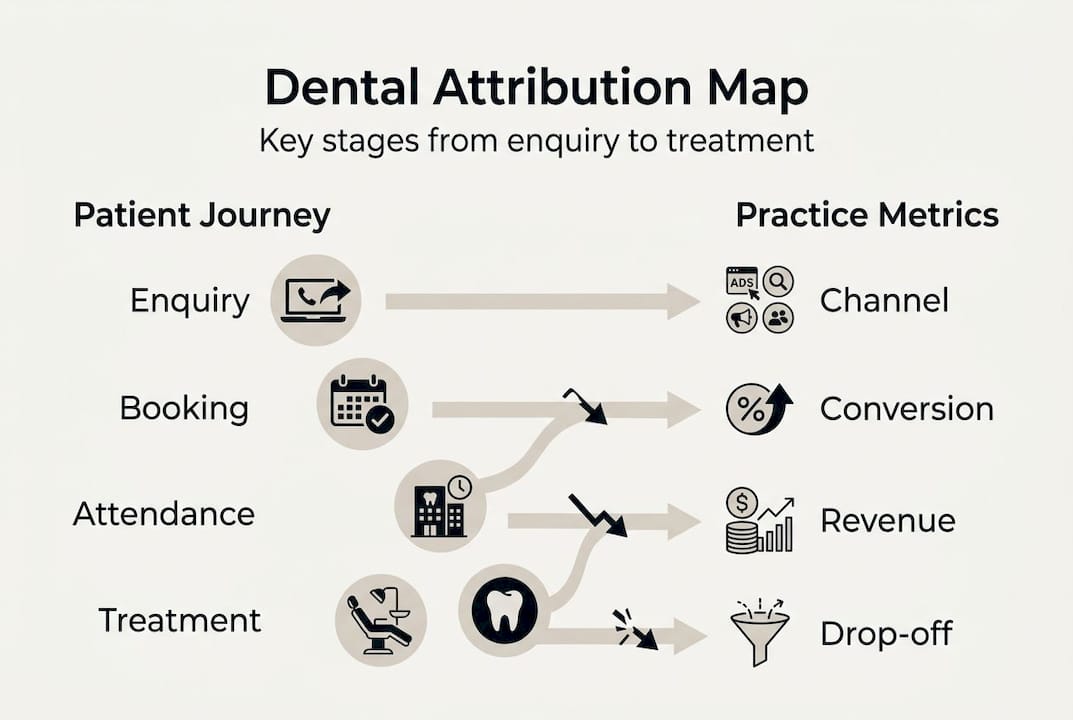
The patient journey in dentistry typically moves through four distinct stages:
- Enquiry — a potential patient contacts the practice via phone, webchat, email, or WhatsApp
- Booking — the enquiry converts into a scheduled appointment
- Show — the patient attends the appointment
- Treatment — the patient accepts and completes a treatment plan
Each of these stages is a conversion point. Lose a patient at any one of them and you lose the revenue attached to that journey. Calculating revenue leakage across these stages often reveals significant gaps that practices had no idea existed.
Here is a straightforward comparison between superficial and meaningful attribution:
| Metric type | What it measures | What it tells you |
|---|---|---|
| Clicks and impressions | Ad or page interactions | Traffic volume only |
| Form submissions | Enquiry volume | Potential interest |
| Booked appointments | Enquiry to booking rate | Conversion efficiency |
| Attended appointments | Show rate | Patient commitment |
| Completed treatments | Revenue per channel | True marketing ROI |
The difference is significant. Superficial metrics give you activity data. Meaningful attribution gives you revenue data.
"Attribution in dentistry should be built around the patient journey and multiple conversion points."
This is the shift that changes how you run your practice. When you know which channels produce patients who actually show up and accept treatment, you can invest confidently and stop guessing.

Mapping the patient journey for actionable insights
With a clear sense of attribution, you can now focus on mapping the patient journey for actionable insights. Each stage of the journey produces distinct data, and each data point tells you something different about your acquisition process.
Here is how the stages break down in terms of what they reveal:
| Journey stage | Key metric | Business insight |
|---|---|---|
| Enquiry received | Volume by channel | Which channels generate demand |
| Enquiry to booking | Conversion rate | Front desk or response effectiveness |
| Booking to show | Show rate | Appointment reminder quality |
| Show to treatment | Acceptance rate | Consultation and case presentation |
| Treatment value | Revenue per patient | Channel profitability |
As the data shows, actionable booking data is far more informative than click counts alone. Tracking booked appointments and show rates gives you a real picture of where patients are dropping off and where your team is performing well.
To improve your tracking at each stage, follow these steps:
- Define your stages clearly. Agree internally on what counts as an enquiry, a booking, a show, and a completed treatment.
- Assign a source to every enquiry. Whether it comes via phone, WhatsApp, or webchat, record where it originated.
- Track conversion rates between stages. Calculate what percentage of enquiries become bookings, and what percentage of bookings result in attended appointments.
- Connect treatment value to the original source. This is the step most practices skip, and it is the one that reveals true ROI.
- Review the data monthly. Attribution is only useful if it informs decisions on a regular cycle.
Gaining patient pipeline visibility across all of these stages transforms attribution from a theoretical exercise into a practical management tool.
Pro Tip: Train your front desk team to ask every new patient how they heard about the practice, and record that answer in your system at the point of booking. Consistent intake data is the foundation of reliable attribution.
Overcoming attribution challenges in dental practices
Understanding the journey highlights a new set of challenges in attribution accuracy. Let's examine these and ways to overcome them.
Attribution in dentistry is rarely straightforward. A patient might see your Google ad, visit your website three times, receive a recommendation from a friend, and then call the practice directly. Which channel gets the credit? This is the multi-touch problem, and it affects every practice that runs more than one marketing channel.
The main obstacles to accurate attribution include:
- Multi-touch journeys — patients interact with multiple channels before converting
- Offline phone leads — calls are often untracked or inconsistently recorded
- Fragmented data — enquiries arrive via different platforms with no central record
- Inconsistent front desk intake — source data is not always captured at booking
- No link between enquiry and treatment value — systems do not connect marketing data to clinical outcomes
"Attribution accuracy is inherently limited by multi-touch journeys and imperfect data integration."
This is an important reality to accept. Perfect attribution does not exist. The goal is not perfection — it is decision-grade attribution. That means having data that is consistent enough and reliable enough to guide your next marketing investment with confidence.
Strategies that help you get there include:
- Centralise all enquiries into one system so every channel is captured in the same place
- Use call tracking to attribute phone leads to specific campaigns or channels
- Establish consistent source capture rules so your team records the same information every time
- Apply a simple attribution model such as first-touch or last-touch, and stick to it consistently rather than switching between models
Revenue intelligence starts with consistent data capture, not complex modelling. And data integration across your channels is what makes that consistency achievable at scale.
Pro Tip: Do not let perfect be the enemy of useful. A consistent, simple attribution rule applied across all channels will give you better business insight than an elaborate model applied inconsistently.
Applying revenue attribution to drive business decisions
Having tackled the attribution hurdles, it is time to turn these insights into practical business improvements.
Attribution data is only valuable when it changes how you make decisions. The most immediate application is marketing spend. When you know which channels produce patients who book, show, and complete treatment, you can redirect budget away from channels that generate clicks but not conversions.
Statistic callout: ROI tracking fails when practices track clicks instead of booked outcomes — meaning the majority of dental marketing spend may be evaluated against the wrong metric entirely.
Here are the most impactful ways to act on your attribution data:
- Calculate cost per acquisition by channel. Divide your spend on each channel by the number of treated patients it produced, not the number of clicks.
- Identify your highest-value channels. Some channels may produce fewer enquiries but higher treatment acceptance rates. These deserve more investment.
- Spot drop-off points. If enquiries are high but bookings are low, the problem is in your response process. If bookings are high but shows are low, the problem is in your reminder workflow.
- Set revenue targets per channel. Once you know what each channel produces, you can set realistic expectations and measure against them.
- Review quarterly and adjust. Attribution data should drive a regular review cycle, not a one-off audit.
Steps to reduce wasted spend and improve ROI:
- Audit your current channels against booked and treated patient outcomes, not traffic.
- Pause or reduce spend on channels with high click volume but low conversion rates.
- Increase investment in channels where cost per treated patient is lowest.
- Use your revenue leakage calculator to quantify the financial impact of current drop-off rates.
- Explore revenue-based pricing plans that align your tools with the outcomes you are trying to achieve.
Attribution done well does not just tell you what happened. It tells you what to do next.
Why most dental attribution efforts fail — and what actually works
Let's be direct about something most marketing guides avoid saying. The reason attribution fails in dental practices is not a technology problem. It is a consistency problem.
Practices invest in tracking tools, set up dashboards, and then continue recording enquiry sources inconsistently at the front desk. The data becomes unreliable within weeks. Decisions get made on gut feel anyway, and the attribution system is quietly abandoned.
What sets successful practices apart is not a more sophisticated model. It is a simpler, more disciplined one. They pick a clear attribution rule, train their team to capture source data every single time, and review the numbers on a fixed schedule. They use patient pipeline insights to spot patterns rather than chasing precision.
The contrarian truth is this: a consistent, imperfect attribution system beats an accurate but inconsistently applied one every time. Vanity metrics mislead you because they feel like progress. Real attribution feels uncomfortable at first because it reveals gaps. But those gaps are where your revenue growth is hiding.
Powerful tools for dental revenue attribution
If the frameworks in this article have highlighted gaps in how your practice currently tracks and converts enquiries, you are not alone — and there are practical tools designed specifically to close those gaps.
ReplyOS is built to give dental practices full visibility from first enquiry to completed treatment. By centralising WhatsApp, SMS, webchat, and email into a single platform, every enquiry is captured, attributed, and tracked through the pipeline. Use the revenue leakage calculator to see what your practice may currently be losing, explore the pipeline platform to understand how attribution works in practice, or visit how it works to see the full system in action.
Frequently asked questions
What is revenue attribution in dentistry?
Revenue attribution in dentistry means tracking which marketing sources lead to real patient bookings, attendance, and treatments, not just website clicks. It connects marketing activity to actual revenue outcomes across multiple conversion points.
Why isn't tracking website clicks enough for dental ROI?
Website clicks often fail to reflect patient bookings and revenue, so practices need to track conversion points along the patient journey for true ROI. Clicks alone do not reliably produce actionable ROI data in dentistry.
How can I improve attribution accuracy in my practice?
Capture both online and phone leads consistently, and map out every stage from enquiry to treatment for actionable decision-grade attribution. Front desk intake consistency is vital for maintaining data accuracy over time.
Does perfect revenue attribution exist?
Perfect attribution is not possible. The aim is consistent, decision-grade attribution that highlights clear trade-offs to guide business actions. Multi-touch journeys inherently constrain attribution accuracy in any practice.
How can attribution data help improve revenue?
By revealing which channels drive bookings and treatments, practices can optimise marketing spend, lower acquisition costs, and grow revenue. Attribution helps practices reduce waste and focus investment on what demonstrably works.