
Unfilled appointment slots cost dental practices far more than most owners realise. Every missed booking represents lost clinical time, wasted overhead, and a patient who may never return. The good news is that the gap between a half-full diary and a thriving, fully booked practice is not as wide as it looks. With the right combination of communication strategy, digital tools, and process discipline, you can meaningfully increase your appointment rate, reduce no-shows, and give patients a booking experience they actually enjoy. This guide walks you through exactly how to do that, step by step.
Table of Contents
- Identify key criteria for improving dental bookings
- Embrace multi-channel reminders and personalisation
- Streamline online booking and inquiry management
- Introduce deposits and clear policies for high-value appointments
- Continuously optimise with workflow management techniques
- Why process and personal touch beat technology alone
- Supercharge your dental bookings with the right platform
- Frequently asked questions
Key Takeaways
| Point | Details |
|---|---|
| Personalise reminders | Tailoring multi-channel reminders to patient risk dramatically lowers no-shows. |
| Automate online booking | Frictionless inquiry and booking tools boost patient attendance and simplify management. |
| Use deposits for big appointments | Deposits protect high-value time slots and reduce costly cancellations. |
| Audit workflows regularly | Continuous workflow optimisation delivers steady booking improvements and higher efficiency. |
Identify key criteria for improving dental bookings
Before you invest time or money into any booking improvement strategy, you need a clear framework for evaluating what will actually move the needle. Booking volume is an obvious metric, but it tells only half the story. A practice that books 40 appointments a week but loses 10 to no-shows is performing worse than one that books 30 and retains all of them.
When assessing any improvement, focus on these five criteria:
- Patient experience: Is the booking process frictionless and reassuring for the patient?
- Team workload: Does the solution reduce administrative burden or add to it?
- No-show reduction: Will this measurably lower your missed appointment rate?
- Flexibility: Can it adapt to different appointment types, patient profiles, and team sizes?
- Return on investment: What is the realistic revenue impact over 90 days?
Start by gathering your current data. What is your fill rate? How many appointments go unfilled each week? What is the average value of a missed appointment? These numbers give you a baseline. Without them, you are guessing.
Workflow discipline matters here too. Lean Six Sigma for dental workflows reduces scheduling delays by 20 to 40%, which shows just how much structured process improvement can shift outcomes. You do not need to implement a full Lean programme overnight. Even small changes, like standardising your booking scripts or mapping your enquiry-to-confirmation journey, can reveal costly bottlenecks quickly.
Set realistic targets based on your baseline data. If your current fill rate is 75%, a target of 85% within 90 days is achievable with focused effort. Tracking progress against a defined goal keeps your team motivated and your investment justified.
Embrace multi-channel reminders and personalisation
Once you know what you are measuring, communication becomes your most powerful lever. Many practices still rely on a single reminder channel, typically an automated SMS sent 24 hours before the appointment. It is better than nothing, but it consistently underperforms compared to a layered approach.

Patients are different. Some respond immediately to a text. Others ignore them entirely but will always answer a phone call. A reminder strategy that treats every patient the same will always leave results on the table.
Here is a practical three-step reminder sequence that works well for most practices:
- Send a confirmation message immediately after booking via the patient's preferred channel, whether that is email, SMS, or WhatsApp.
- Follow up 72 hours before the appointment with a friendly reminder that includes a simple option to confirm, reschedule, or cancel.
- Make a personal phone call 24 hours before for high-risk patients, such as those with a previous no-show history or high-value treatment booked.
Multi-channel reminders outperform single-channel approaches, particularly when personalised by patient risk profile. Segmenting your patient list into low, medium, and high risk for no-shows lets you allocate your team's time where it counts most.
"Patients who receive a personal call before a high-value appointment are significantly more likely to attend than those who receive only an automated message."
Pro Tip: Keep all reminder messages short, warm, and action-oriented. Include the appointment time, the practitioner's name, and one clear action for the patient to take. Avoid lengthy policy text in reminders as it reduces read rates.
For multi-channel reminder tools that automate this process without adding team workload, look for platforms that allow channel selection by patient preference and risk category.
Streamline online booking and inquiry management
Communication strategy and booking accessibility go hand in hand. Even if your reminders are excellent, a clunky booking process will lose patients before they ever confirm. Today's patients expect to book quickly, often outside of your opening hours, and without waiting on hold.
Delays in responding to enquiries are particularly costly. A patient who contacts three practices and receives a response from only one will book with that one, regardless of price or location. Speed of response is now a competitive advantage.
When comparing booking solutions, evaluate them against these key features:
| Feature | Phone bookings | Online forms | Integrated platforms |
|---|---|---|---|
| Response speed | Dependent on staff | Hours or days | Instant, 24/7 |
| Calendar integration | Manual | Limited | Automatic |
| Staff workload | High | Medium | Low |
| Patient experience | Variable | Moderate | Consistent |
| Confirmation speed | Slow | Slow | Immediate |
Online and AI booking tools show measurably higher attendance rates and revenue per patient compared to traditional phone-only systems. The shift is not just about convenience. It is about removing every possible reason a patient might abandon the booking process.
Pro Tip: Build a library of response templates for your most common enquiries, such as new patient registrations, hygiene appointments, and Invisalign consultations. Templates reduce response time dramatically and ensure consistent, professional communication every time.
Using real-time booking data from your platform also allows you to spot patterns, such as peak enquiry times or common drop-off points, and adjust your processes accordingly.
Introduce deposits and clear policies for high-value appointments
Digital systems reduce friction for patients, but financial accountability reduces risk for your practice. Requiring a deposit for high-value treatments is one of the most straightforward ways to protect your diary from last-minute cancellations.
Deposits work because they create a psychological and financial commitment. A patient who has paid £50 towards their whitening or implant consultation is far more likely to attend than one who has made a free, low-commitment booking. They also filter out patients who were never truly serious about proceeding.
Best practices for implementing deposits include:
- Set the deposit at 10 to 20% of the treatment cost for procedures over £150, keeping it meaningful without being prohibitive.
- Clearly state your refund policy at the point of booking. A deposit that is refundable with 48 hours' notice is fair and rarely disputed.
- Communicate the policy in writing via your booking confirmation message so there is no ambiguity.
- Apply deposits consistently across all patients for the same procedure types to avoid any perception of unfairness.
Deposits for high-value procedures significantly reduce missed appointments, making them one of the highest-impact, lowest-cost changes a practice can make.
Key stat: A single missed implant consultation can represent £200 to £500 in lost potential revenue. Across a year, even a modest reduction in no-shows for premium treatments can add thousands to your bottom line.
Transparency is everything here. Patients rarely push back on deposits when the policy is explained clearly and applied fairly. Frame it as a way to secure their appointment and guarantee the clinician's time is reserved exclusively for them.
Continuously optimise with workflow management techniques
Financial discipline protects your calendar in the short term. Sustained booking growth, however, comes from treating your processes as something that can always be improved. This is where regular workflow reviews become essential.
A booking audit does not need to be complex. Set aside 30 minutes each month to review your key metrics:
- Enquiry-to-booked conversion rate: What percentage of inbound enquiries result in a confirmed appointment?
- Patient wait time: How long does a patient wait between first contact and their appointment date?
- Staff response rate: How quickly does your team respond to new enquiries, and how consistently?
Once you have these numbers, you can identify where the biggest losses are occurring and prioritise fixes accordingly.
| Workflow improvement | Expected impact |
|---|---|
| Triage intake forms | Reduces call time by 15 to 25% |
| Automated confirmation messages | Cuts no-shows by up to 30% |
| Script templates for common queries | Improves response consistency |
| Dedicated booking staff during peak hours | Increases conversion rate |
Applying Lean Six Sigma methods to dental scheduling can reduce delays by 20 to 40%, which translates directly into more appointments completed and fewer gaps in the diary. You do not need a consultant to get started. Map your current process, identify the three biggest friction points, and address them one at a time.
Explore workflow improvement strategies that combine automation with team accountability to build a booking operation that improves month on month.
Why process and personal touch beat technology alone
Here is something the technology vendors rarely tell you: the practices that see the biggest booking improvements are not the ones with the most sophisticated software. They are the ones that combine smart tools with genuine process discipline and a commitment to personal service.
Automation is powerful. It removes repetitive tasks, speeds up response times, and scales your communication without scaling your headcount. But it amplifies whatever process it is built on. If your underlying booking process is fragmented or inconsistent, automation will simply make those problems faster.
Some practice owners resist adopting AI or online booking tools, worried that it will make their practice feel impersonal. That concern is understandable, but workflow optimisation with digital tools consistently shows improved patient outcomes and satisfaction scores alongside efficiency gains. The data supports it.
The real advantage comes from treating technology as an enabler of better human service, not a replacement for it. Use automation to handle the routine so your team can focus on the moments that genuinely require a personal touch: the anxious first-time patient, the complex treatment discussion, the follow-up call after a difficult procedure. That balance is where lasting patient loyalty is built.
Supercharge your dental bookings with the right platform
The strategies in this article work. But implementing them across separate tools, managing reminders in one system, bookings in another, and enquiries in a third, creates the very fragmentation that costs practices revenue in the first place.
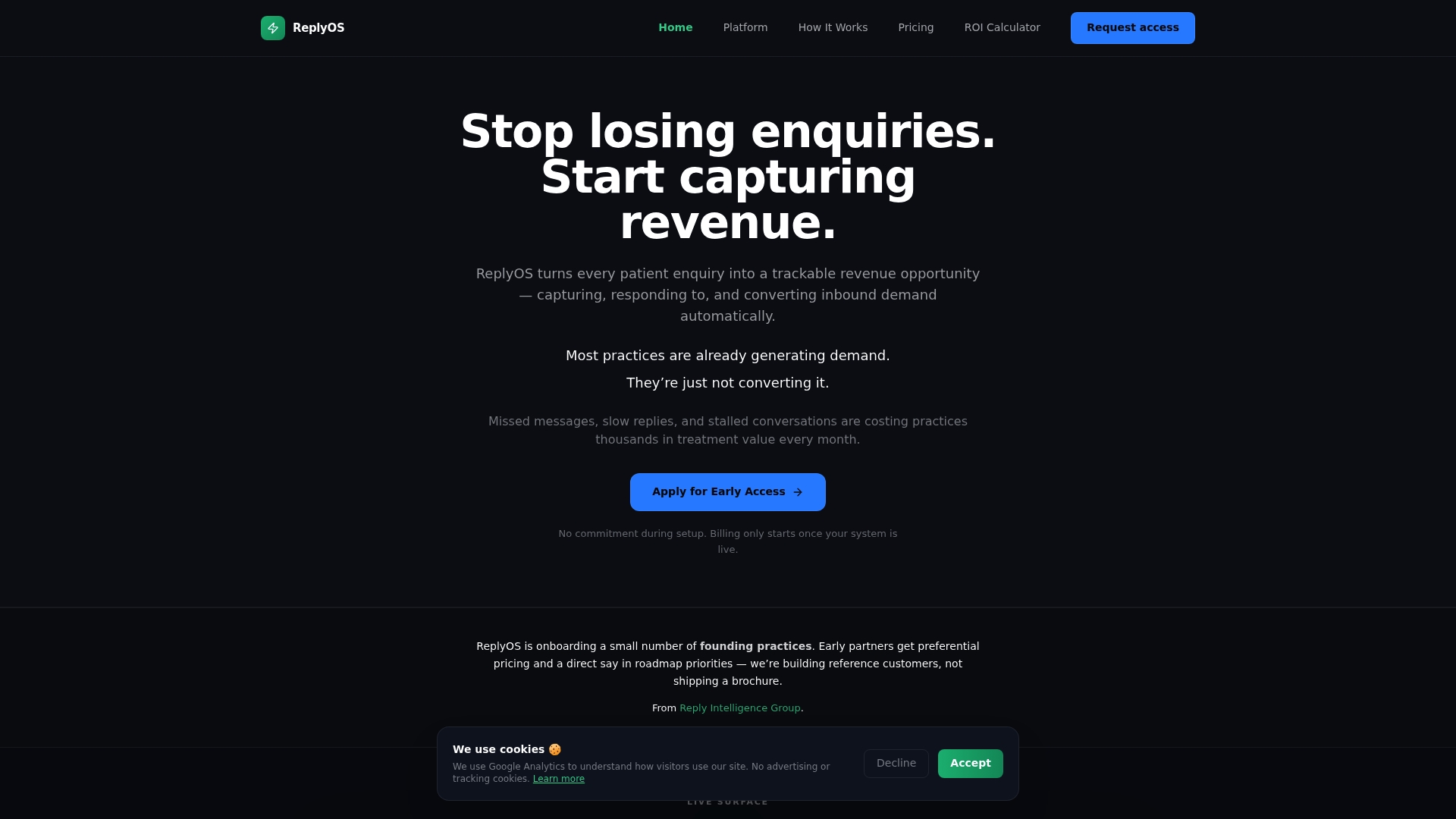
ReplyOS brings reminders, online booking, enquiry management, and workflow tracking into a single system built specifically for dental practices. You can see lost revenue from missed bookings with our revenue calculator, then track your patient pipeline from first message to confirmed appointment. Want to see it in action? Explore how ReplyOS streamlines bookings and discover what a fully connected booking operation looks like for your practice.
Frequently asked questions
What is the most effective way to prevent dental appointment no-shows?
Combining multi-channel reminders with personalisation based on patient risk profile consistently delivers the best results. Patients with a history of no-shows benefit most from a direct phone call rather than an automated message alone.
Does requiring a deposit for treatment bookings reduce cancellations?
Yes. Deposits for high-value procedures significantly reduce both no-shows and last-minute cancellations by creating a financial and psychological commitment to the appointment.
How can online booking tools impact practice revenue?
Online and AI booking tools show higher attendance rates and increased revenue per patient compared to phone-only systems, largely because they remove friction and enable 24/7 access to scheduling.
Is Lean Six Sigma really effective for dental clinics?
Absolutely. Lean Six Sigma methods applied to dental scheduling can reduce delays by up to 40%, freeing up clinical time and improving the overall patient experience without significant additional investment.